Teacher: Can you SEE what I'm saying ? A research experience with deaf learners

Teacher:  Can you SEE what I'm  saying ?  A research experience with deaf learners

sábado, 3 de abril de 2010

What to do with the collected data?

Any Action Research project involves reading and analyzing the data gathered by the different instruments. What to do with the collected data?

These were the steps followed to deal with the collected data.

First Step : Assembling the data

•Re-reading the data and beginning the detailed analysis process.

•Seeing if data are useful to answer the initial research questions

•Using a website to analyze the surveys qualitatively and quantitatively.

In order to do this first step properly, it was necessary to use the tools given by Encuestafacil.com to get an organized chart including the survey results. In addition, the interview was transcribed and some researcher's logs and some students' artifacts were chosen.

After analyzing the survey's questions, I noticed that some were not very useful; they just provided data about the participants' characteristics.

Second Step : Coding the data

•Examining the data and Identifying broad and frequent patterns.

• Applying a color-coding system.

For this process, the tutor's help was very effective to "recognize" the patterns and categories.

Thus, yellow color was used to identify the information about Internet in a blended course

(sub-question Nº1) and green color coded all the patterns that gave information about Collaborative work

( sub-question Nº 2)

Third Step: Comparing data

  • Identifying the repeated patterns across the data gathering techniques.
  • Analyzing the data gathered, its patterns and other data emerged from the process.
  • Identifying the relationships and connections between the data and the research questions.

The tutor suggested me to design this chart which was useful to analyze the data by focusing on the research questions.

QUESTIONS

What does the use Internet resources in an English course tells us about the language learning process of deaf university students?

· What insights about collaborative learning can be identified in an English course for

deaf students ?

CATEGORIES

· The use of Internet resources in a blended course as an effective didactic strategy.

· The language learning process of deaf students and the use of activities linked to visual media and written text production.

· ·Positive incidence of the collaborative work on the English learning process of deaf students.

Fourth Step : Summarizing trends and building Interpretations

Judging the value of data regarding the research question and sub questions .

Identifying concepts, ideas and interpretations emerged from the data collected.

Drawing conclusions.

Fifth Step : Writing a data analysis report

The report shows the research systematic process and present its findings.

The last two steps were so difficult for me. This writing task demanded a lot of time and effort; organizing the results and building a coherent paper implied to re-read the data several times trying to find possible " connections" and new interpretations

sábado, 27 de marzo de 2010

Data Collection Instruments

February 17, 2010

This research project has involved the use of different data collection instruments such as an initial and a final survey, some researcher's logs, a recorded interview and some written products done by students that are called artifacts.


The initial survey
This instrument was applied to know students' motivation towards the English learning and their relationship with some instructional technology.It enabled me to have a general characterization of the participants.
See
http://www.encuestafacil.com/RespWeb/Qn.aspx?EID=662546


The final survey
This instrument provided specific data about the particular process of the deaf participants and the effect of using some EFL Internet resources on the design and development of an English course for them. It was also applied to know the students' opinion about the blended methodology used during the course.
See
http://www.encuestafacil.com/RespWeb/Qn.aspx?EID=662553

Sagor ( 2000 p.104) considers surveys popular instruments because they are efficient and versatile, useful for gathering data about different fields.

The researcher's logs.
These short paragraphs including my personal perspective of the learning process of my deaf students, they were useful to get some insights about the classroom interaction and the students' reactions during the face-to-face sessions.

The artifacts
The simple sentences or short paragraphs written by students during the process were useful to determine to what extent the deaf students writting skills have changed after the pedagogical intervention.

The video-recorded Interview
While doing the interview's transcript, I noticed the advantage of getting visual and verbal responses by means of a video-recorded interview. I could identify some aspects relevant for participants, their perceptions and their believes about the English course.

Reference
Sagor, R. ( 2000 p. 104) How to conduct Collaborative Action Research. Alexandria. VA, U.S.

viernes, 20 de noviembre de 2009

My students' first paragraph


This week I asked my students to write a little paragraph about themselves. It was very exciting to see their first texts.They are careful with aspects like grammar and syntax.
These are just two examples

Dear teacher Olga

How are you? I am Jesus Antonio, i am student of technological design at National Pedagogical University. I like learning in english class.
My teacher is good education for the deaf students, she likes learning a Colombian sign language and we are happy of learning english.

Jesus Monroy


Hello, I am Edith Rodríguez. I´m twenty four years old. I am very intelligent, beautiful, funny and nice. I´m a pschy pedagogy student at National pedagogical University. I´am good worker and I´am very happy at the deaf community. I´am interested in english class to learn nev english words.

Love

Image taken from http: // 64.76.64.kolores/images/photos/escribiendo%20en%20el%20pizarrón

jueves, 12 de noviembre de 2009

The last data collection instrument

Image taken from http://www.bragfolio.com/CMFiles/Images/Interview%20Logo.jpg
November 10


The university is open again. There are only eleven deaf students in class. It seems that the others have a lot of academic work because the semester is finishing and they decided not coming to class.
Today, I applied another data collection instrument: the formal interview. It gave students the opportunity to express their insights and opinions about the English course. This semi- structured interview was designed in Spanish to facilitate the interpreter's comprehension and translation. In addition, it was flexible enough to enable students to talk freely about the aspects they considered relevant. It allowed for " the emergence of themes and topics which may have not been anticipated when the investigation began ". (Burns, 1999, p. 120)
In general, most students were very collaborative and their comments were interesting and useful to improve not only the research project but also the teaching process.

Reference
Burns, A. ( 1999) Collaborative Action Research for English Language Teachers.CUP.

November 3

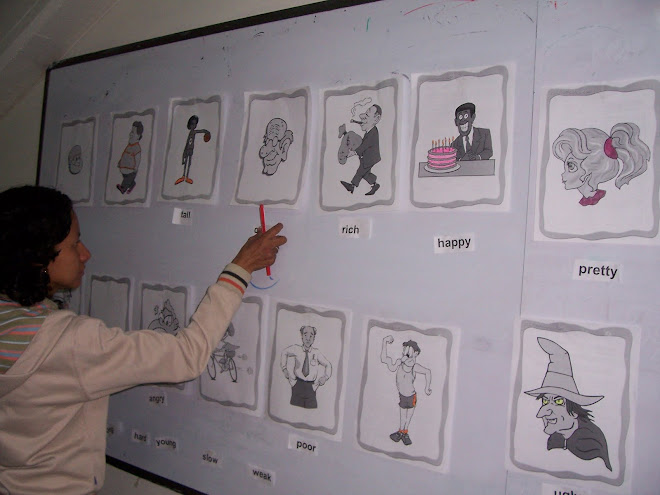
Seven students arrived to the school, but the interpreter and the filmmaker did not. When I started the class, I was a little nervous because I did not have sign language support. However, my deaf students were very helpful because they have learned to “interpret” my own gestures and I had brought a lot of labelled visual support. It was amazing! Fortunately, after forty minututes another deaf student showed up accompanied by a guy who also works as interpreter at U.P.N. and he kindly helped me

Iamge taken from http://gua30.files.wordpress.com/2008/05/voluntarios.jp

A learning space can be physical or virtual


image taken from http://redesuniversitarias.blogia.com/


October 27


The university classrooms have been blocked. There are no regular academic classes. I have been in contact with my deaf students by e-mail. They have explored some EFL Internet resources to reinforce basic concepts. I just wanted to show them a variety of available learning resources which help them to identify their language needs and make decisions to support their professional growth.
Nunan ( 1996,p.298) proposes awareness as the starting point to empower students' role in their learning process and finding a new way of interaction with their peers and teachers to be more autonomous.
Today, I have written a message inviting them to have our F2F class in the school where I work, near U.P.N. I think that this is a good excuse to see their autonomy and interest on the course. Some of them have accepted.

Reference
Nunan,D. ( 1996 p. 298). Towards autonomus learning: Som tehorretica, empirical and practical issues.

First results


§ Pucca is very ideal.

§ She loves Guru.

§ She is learning.

§ She is short


Andrea Riaño's virtual homework.


October 13


Some deaf students have been very responsible with their virtual homeworks. Today, I spent the F2F session giving them feedback about their tasks. I noticed they liked to be corrected by giving them “visual” examples and writing the translation of some sentences into Spanish. They like working in teams and receiving the teachers’ or partners’ feedback positively. They require the complete teacher’s attention to solve their doubts, suggestions or difficulties towards the leaning process.
About the project, I have learned some useful signs to have a better classroom management and luckily, I got a new member in my team: Sacha Valdez, a filmmaking student has accepted to attend the classes and record students’ interaction. This project is attractive for everyone!